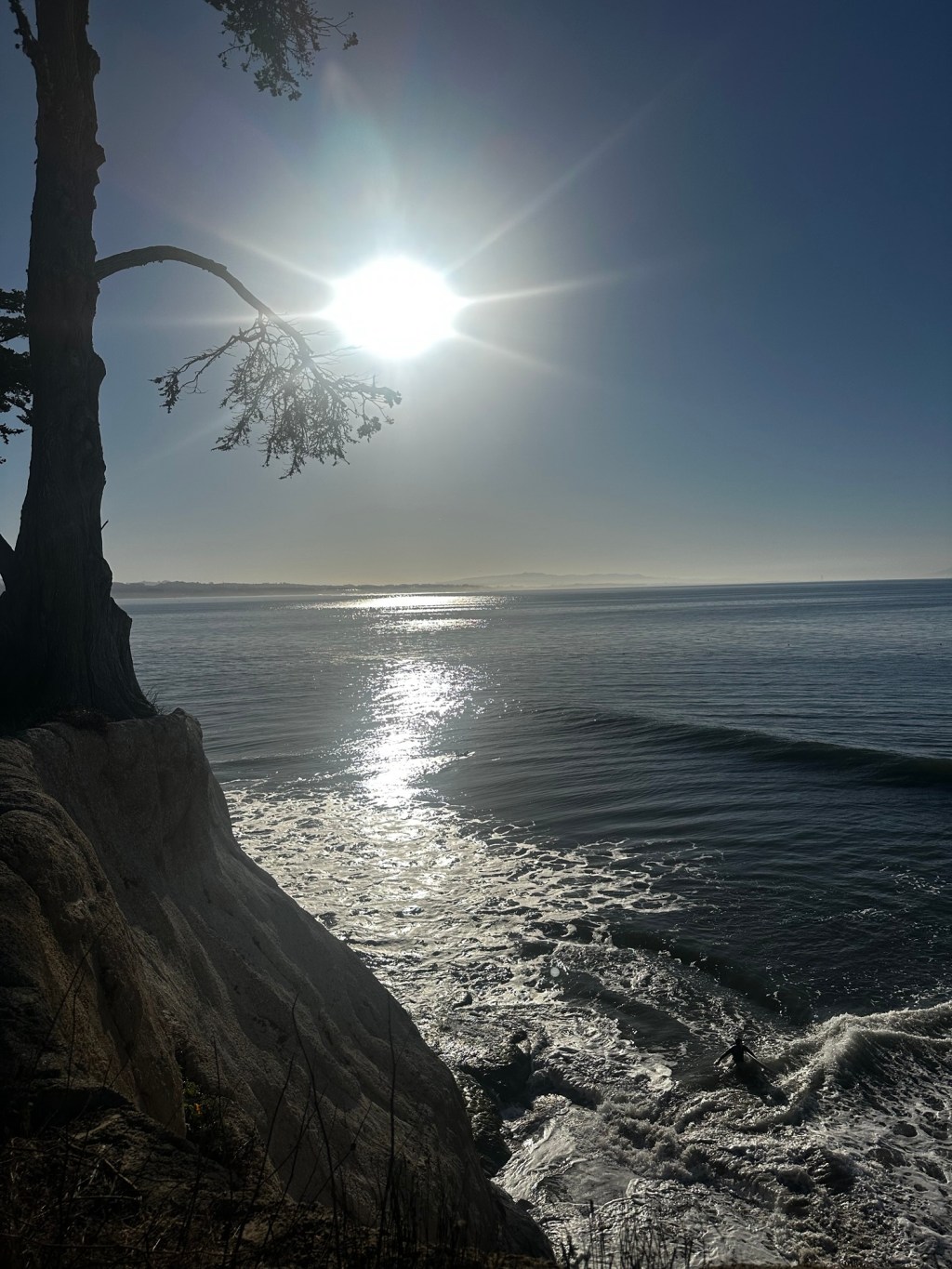
CAPITOLA – October 25, 2025. The rain started the moment I hit my stride.
I could smell it coming, that metallic earthiness that arrives just before the drops. But I stubbornly ignored it, determined to stick to my plan. Drops on my face. Salt air mixing with wet pavement. My AirPods still playing, podcast host mid-sentence about something I was already forgetting. I’d planned this Saturday walk along East Cliff all week, a rare morning without the laptop chained to my hip, and now the sky was ruining it.
I stood there for a moment, frustrated, ready to turn back. Then I remembered: I didn’t actually have to be anywhere. A rare Saturday with no plans. No dinner reservations. No prebooked yoga class. No family gathering pulling me forward.
So I ducked into Two Birds Books instead.
“Hi Reem,” Gary greeted me as I stepped through the door, wiping my feet on the mat. He owns the shop with his wife Denise, who still teaches at UC Santa Cruz.
“Reading anything interesting lately?” Gary asked.
I told him about “The Good House” by Ann Leary. Started going on about the beef stew I’d made yesterday because of the book. Gary’s patient smile alerted me to my rambling.
“What have you been liking lately?” I asked quickly.
“My favorite book of the year,” he said, reaching for a display copy. “The Correspondent” by Virginia Evans.”
So I bought the book, found a lucky seat in the crowded Verve coffee shop, switched my AirPods to classical music, and settled in.
The music played softly, drowning just the right level of conversation around me. I sunk into the first pages of my book. That beautiful feeling of textured paper between my fingers transported me to the protagonist’s room, holding her letters. The warm ceramic mug in my hands, steam carrying that medium roast scent that somehow smells like its caramel color. The first sip, full and chocolaty before the pleasant bitterness arrives. No milk needed. Something baroque and meandering wrapping around me like a familiar blanket.
Some time later, I looked up from the pages. The coffeeshop sounds had melted into the music, conversations and espresso hisses and ceramic clinks all becoming part of one ambient symphony.
Raindrops streaking the windows to my right. People huddling outside under the awning, holding their drinks and talking. In front of me, a line forming at the counter. The barista’s practiced movements, precise and unhurried. Steam rising from the espresso machine. The warm coffee coating my mouth before traveling down my throat.
I was just there. Present. Alive in that moment.
Not planning for the future. Not recalling a memory. Not analyzing or problem-solving. My brain wasn’t sifting for patterns to recognize. It just was.
When had this become so rare? When did presence start requiring so much effort? I keep trying to reclaim what’s slipping away while I save five minutes here, ten minutes there.
Yesterday, I was starved for presence with something other than technology and the virtual world, for time and slowness. After being chained to my laptop until 4 p.m., I logged off and went straight to the kitchen to make beef stew. Those scenes in “The Good House” where they’re eating it, those cozy New England rhythms had gotten to me.
I pulled up the recipe on my phone. Three hours. The time jarred me, seemed aggressive in a world of sheet-pan dinners and instant pot miracles. But then I read closer: three hours, yes, but it’s not complex. It’s just time. My husband wouldn’t be home until 8 p.m. I never eat that late, but I let it go, it was Friday night after all.
As the stew simmered, the kitchen filled with the smell of beef and vegetables slowly transforming. It’s basically the American version of tabeekh, though admittedly blander. Standing there stirring, watching steam rise, I was pulled back to last year’s four months of unemployment when I had nothing but time. When I learned that everything worth making: a strawberry reduction, a proper cake, a beef stew… takes hours, not because it’s difficult, but because transformation doesn’t hurry.
When time changed
Growing up between Saudi Arabia and Jordan, time moved differently. Afternoons belonged to family “Ghada,” the biggest meal of the day, then everyone took a nap while I laid reading my book in that rare silence of a full house. Weekends stretched long, chores and mall outings, many invented elaborate games with my sisters. Time wasn’t something we saved or spent. It just was.
In the summers at my grandmother’s Jordan home, the doorbell would ring and an uncle would appear unannounced at any time, often mealtime and asked to join.
As a child, in those long summer evenings, I’d sprawl on the floor listening to adult conversations that seemed to have no beginning or end. When my mom would force us to bed, the adults stayed up, their laughter roaring through the walls. I’d lie there jealous, inventing excuses to come back out: a glass of water, a forgotten kiss goodnight.
I thought of what scheduling “quality time” or “finding time on the calendar” would have translated to in the 80s or 90s and the sound of my own chuckle brought me back to the present moment.
The gradual theft
Even when I first moved to America at 17, I didn’t feel this constant pressure. The shift came later, as I progressed through my 30s. Seeds planted after the 2008 recession when jobs became scarce and precarious. Suddenly I was conscious of a new fear: getting laid off, staying relevant, being expendable.
I learned to move faster. To be better, more accomplished. The immortality of my teens and twenties fading. I packed my calendar, measured my worth in achievements, felt guilty about unstructured hours.
American opportunity comes with a badge of busyness we can never take off. The work never ends. It’s always there, hovering in my mind, invading my dreams, rushing me through yoga class, intruding on my walks at the ocean.
People back home see our opportunities here and think we’re lucky. We absolutely are. But they don’t see the invisible tax we pay, how the same system that offers so much possibility also colonizes every hour of our consciousness. I have both worlds in me, which means I know what I’m missing.
The day never takes me. I take the day. I’m always in charge, chained to my calendar.
My weekends fill with errands and projects and things I “should” do. Even my downtime comes with invisible quotas. Read more books. Learn that skill. Shave off a few minutes of my morning routine.
Three of my close friends have parents who faced serious illnesses suddenly this year. One already died. Life isn’t some distant thing I’m preparing for. It’s happening now, while I’m trying to optimize my morning routine.
The four months
Around this time last year, I lost the job I’d held for a decade. At first, I panicked. Updated my resume with the fervor of prayer. Networked like my survival depended on it, which it did. Created an excel sheet of my applications and networking goals. But after a few weeks, something shifted. Or maybe broke open.
I started walking Capitola without destination. No podcast. No purpose. Just the slap of feet on pavement, salt air working its way into my lungs. Some days I’d wander half of the day and couldn’t tell you a single thought that crossed my mind.
I discovered the village’s private face, weekday mornings, off-season, when it sheds its tourist costume. The same elderly couple always on the bench by the wharf at 9:30. The man who feeds the seagulls (on purpose) in front of Zelda’s. October light hitting the cliffs like honey. Fall and winter sunsets that looked apocalyptic, the sky bleeding colors that don’t have names.
One afternoon, I bought watercolors on impulse. I know nothing about painting. But something about watercolors’ refusal to be controlled, how pigment bleeds where it wants, dries how it chooses… it matched something breaking loose in me. I’d sit at my kitchen table or even out on the beach painting and thinking: No one’s grading this. No one will ever see it. I let whatever was trapped inside bleed onto paper, watching colors run together like emotions I couldn’t name.
I bought a stand mixer and spent an entire week learning to bake my nephew’s birthday cake from scratch. No box mix. Real strawberries reduced to syrup, butter whipped into cream. Each layer took time, the reduction alone needed an hour of patient stirring. The cake took three attempts before I got it right. When I finally delivered it, decorated with fresh flowers, I understood something I’d forgotten: the best things can’t be rushed. They take the time they take.
The white space in my calendar stopped feeling like emptiness, it filled my soul.
That entire season, I woke without an alarm. For the first time in my remembered life, my body decided when morning arrived. I’d sit on the porch in yesterday’s clothes watching fog roll back like a tide in reverse.
Then January came with my new job. I had planned this one differently… yes, a significant pay cut but a smaller, local company and more importantly, a shift away from the tech industry. It’s time to break my old habits. Within two weeks, the white space vanished. The walks shortened to errands. The watercolors dried in their tubes. My body learned again to wake before my 5:45 alarm, in time for my pre-work workout, sharp as violence.
I told myself this was the real world. And admittedly, it was a world better than my previous career.
But those four months haunt me. Not because I was happy, happiness is altogether a different thing. I was awake. Present. The days had weight and texture. I accomplished nothing that could go on a resume. I lived everything.
The discipline
In April, I took a month off to travel to the Middle East with my husband. My new employer granted me this unheard-of grace. In my previous world, asking for time off before proving yourself was career suicide. Even with their blessing, I felt the familiar anxiety: would they see me as uncommitted? But this trip had been planned long before the job offer, my husband’s introduction to my extended family and the places that raised me.
After the initial whirlwind of tourism and family introductions, something familiar unfolded. The rhythm I’d known as a child returned like muscle memory. Slow mornings that belonged to no one. Long afternoons dissolving into evening without anyone checking the time. Nap time every single day, not as luxury but as natural as breathing. Tea that materialized whenever someone sat down, conversations that circled back on themselves without resolution or urgency.
I recognized this pace. It was what I’d accidentally recreated during those four unemployed months… that same quality of time that doesn’t march but meanders.
Something awakened. Or maybe just refused to go back to sleep.
When I returned to California, to my new job, to my scheduled life, I tried to hold onto what I’d touched. But the pull of productivity is relentless. Every unscheduled hour feels like theft from my future self. Sitting still feels like failure.
It takes actual discipline now to do nothing. I schedule “walk – no phone” on my calendar. I actively resist turning watercolors into a skill, walks into training sessions, reading into a goodreads challenge.
What I’m learning
I still open my calendar app or my work email app before my eyes clear of sleep’s blur. I still feel guilty on Sunday afternoons when I’m reading instead of producing. I still catch myself trying to extract value from every experience, turn every moment into a lesson, every lesson into something productive.
But this morning, in this coffee shop, rain streaking the windows, I remember what those four unemployed months taught me: that the moments I’m not trying to capture or optimize might be the ones I’m actually living.
The world won’t collapse if I sit here another hour. The emails accumulating like snow won’t melt. The ambitions I’ve been feeding can fast for one morning.
I’m 45. My body carries its own expiration date in every cell. I know the math, if I’m lucky, maybe 40 more years. Two thousand more Saturdays. It sounds like so many until you’ve already spent two thousand and can barely remember a hundred.
Sometimes the most radical thing I can do is exactly this: sit. Let an entire morning dissolve.
There’s rain on the window, baroque music in the air, and a book in my hands that I’ll probably forget in a year.
Right now, that’s not just enough.
That’s everything.
 Heritage Homecoming
Leave a comment