JEDDAH – April 14, 2025. The clock had barely struck 6 a.m. when we set out from Jeddah to Makkah for Nat’s first umrah and my… I lost count. Despite the early hour, I could feel the heat sneaking its way in.
Then and now
Growing up in Jeddah, umrah was something we did a few times each year, typically as a weekday evening family excursion when crowds were lighter. Today, I understand what most Muslims experience: a once-in-a-lifetime pilgrimage requiring significant planning and resources.
The Makkah of my youth never actually stood still. Under Saudi stewardship since the Kingdom’s founding, with King Fahd formalizing the title “Custodian of the Two Holy Mosques” in 1986, the complex transforms continuously, expanding outward and upward. Historic preservation and technological innovation merge as marble courtyards stretch ever wider, air conditioning battles desert heat, and digital systems manage the flow of millions.
Entering the haram
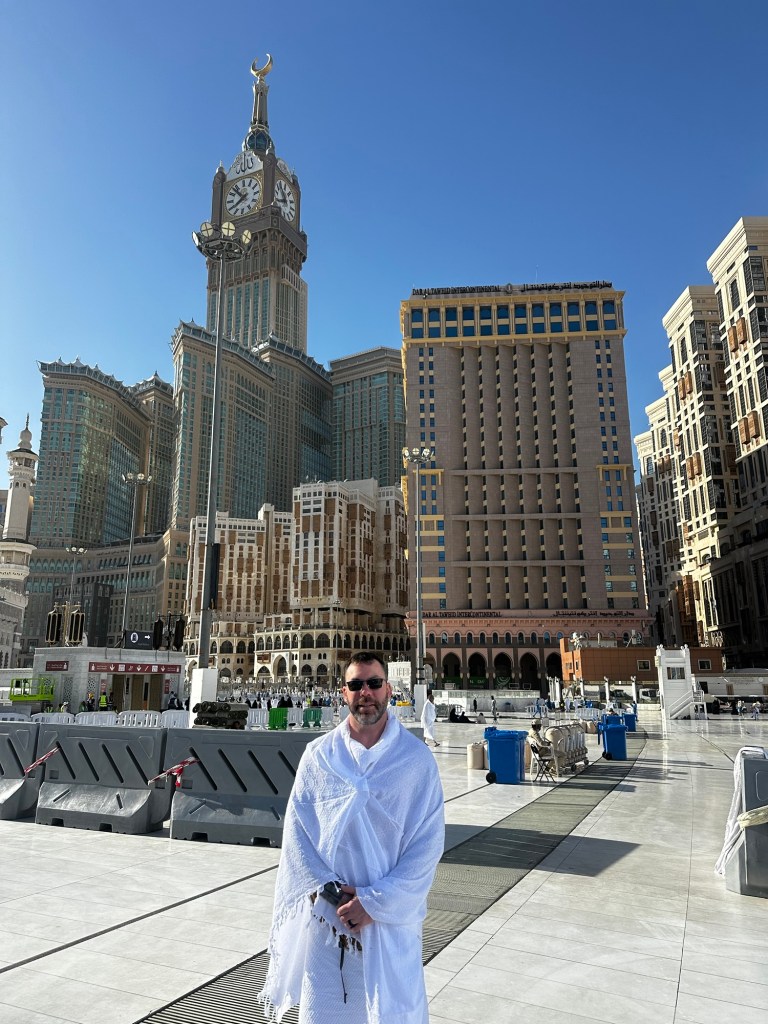
Sunlight bounced off the vast white marble courtyard with blinding brilliance. I squinted against the glare, yet the smooth stone remained cool beneath my bare feet offering a small mercy in the already intensifying heat.
We began our umrah with tawaf, the seven counterclockwise circulations around the Kaaba. The languages surrounding us created a global symphony. The scent of perfumed oils joined the cool marble fragrance and the occasional body odor wafts.
Circling the sacred
The Black Stone, or al-Hajar al-Aswad, set in the eastern corner of the Kaaba, drew the largest crowds during our tawaf. According to Islamic tradition, this sacred stone descended from heaven and was given to Ibrahim by the angel Jibreel. Originally white, the stone is said to have darkened over time from absorbing the sins of humanity.
As we approached the corner housing the stone on each circuit, the crowd density intensified and pilgrims from every corner of the world pushed in aggressively. Guards carefully managed the flow of pilgrims, but the pushing and shoving intensified even though we tried to stay on the outskirts. With each round, the heat, brightness, and sense of claustrophobia grew stronger, creating a test of endurance alongside the spiritual journey. Like most visitors, we simply raised our hands in a respectful wave toward the stone from a distance. “I can hardly believe how many people are trying to reach it,” Nat observed, as we were swept along by the current of bodies circumambulating the Kaaba.
I remembered Umar ibn al-Khattab’s famous words about this very stone: “I know that you are a stone and can neither harm nor benefit. Had I not seen the Prophet kiss you, I would not have kissed you.” His pragmatic wisdom resonates even today amidst the reverence.
Reverence and reflection
After tawaf, Nat and I talked about the Kaaba structure. His months of studying Islamic history had transformed into lived experience, bringing depth to our conversations as we connected ancient narratives to the physical space around us.
“It’s fascinating how this site connects all Abrahamic faiths,” Nat observed. We talked about how Islam embraces the stories of earlier prophets, from Adam to Jesus, including elements that many non-Muslims might not realize are part of Islamic belief, like the virgin birth of Jesus and the covenant with Moses. Standing in this ancient place of worship, the shared heritage of monotheistic religions felt tangible rather than theoretical.
Navigating the crowds, we noticed teams of workers appeared every few minutes with cleaning equipment, ensuring that the millions of daily visitors left no trace on the immaculate surfaces. This meticulous care reflects Saudi Arabia’s $100 billion investment in infrastructure supporting pilgrim experiences.
Our visit came just weeks after Eid al-Fitr celebrations had concluded and before the beginning of the Islamic sacred months when pilgrim numbers traditionally swell, leading up to Hajj. The site was particularly busy with the last Ramadan pilgrims savoring their final days while construction crews worked diligently on Hajj preparations.
Hajar’s footsteps
“I think it’s this way,” my mom said hesitantly as we finished our brief break and headed towards Sa’i, visibly surprised by how much had changed. “Everything looks different from what I remember.” Despite having performed umrah countless times, the recent construction and detours challenged even her experienced sense of direction.
The detours led us to performing Sa’i on the upper level rather than the ground floor. As we took the escalator to the elevated walkway between Safa and Marwa, my mom pointed out how this option didn’t exist in her earlier visits.
Walking between Safa and Marwa seven times, I explained to Nat the historical significance of what we were doing. “We’re retracing Hajar’s desperate search for water for her infant son Ismail,” I told him. “After Ibrahim left them in this valley, she ran between these hills until the well of Zamzam appeared beneath Ismail’s feet.”
Nat noted the modern air-conditioned walkway with its smooth marble bears little resemblance to the harsh landscape Hajar would have experienced. We were walking through history while everything around us evolves.
Past meets present
Hours later, we left Makkah under the blistering midday sun. After 25 years away, I found a kingdom transformed yet faithful to its sacred past, modernity and tradition coexisting in powerful harmony.
In this transformed space, watching Nat created an unexpected bridge between my past and present. This journey became less about returning to my old ritual and more about creating a shared reference point that honored my origins while embracing our life together.


Sa’i upper level area.


 Heritage Homecoming
Leave a comment