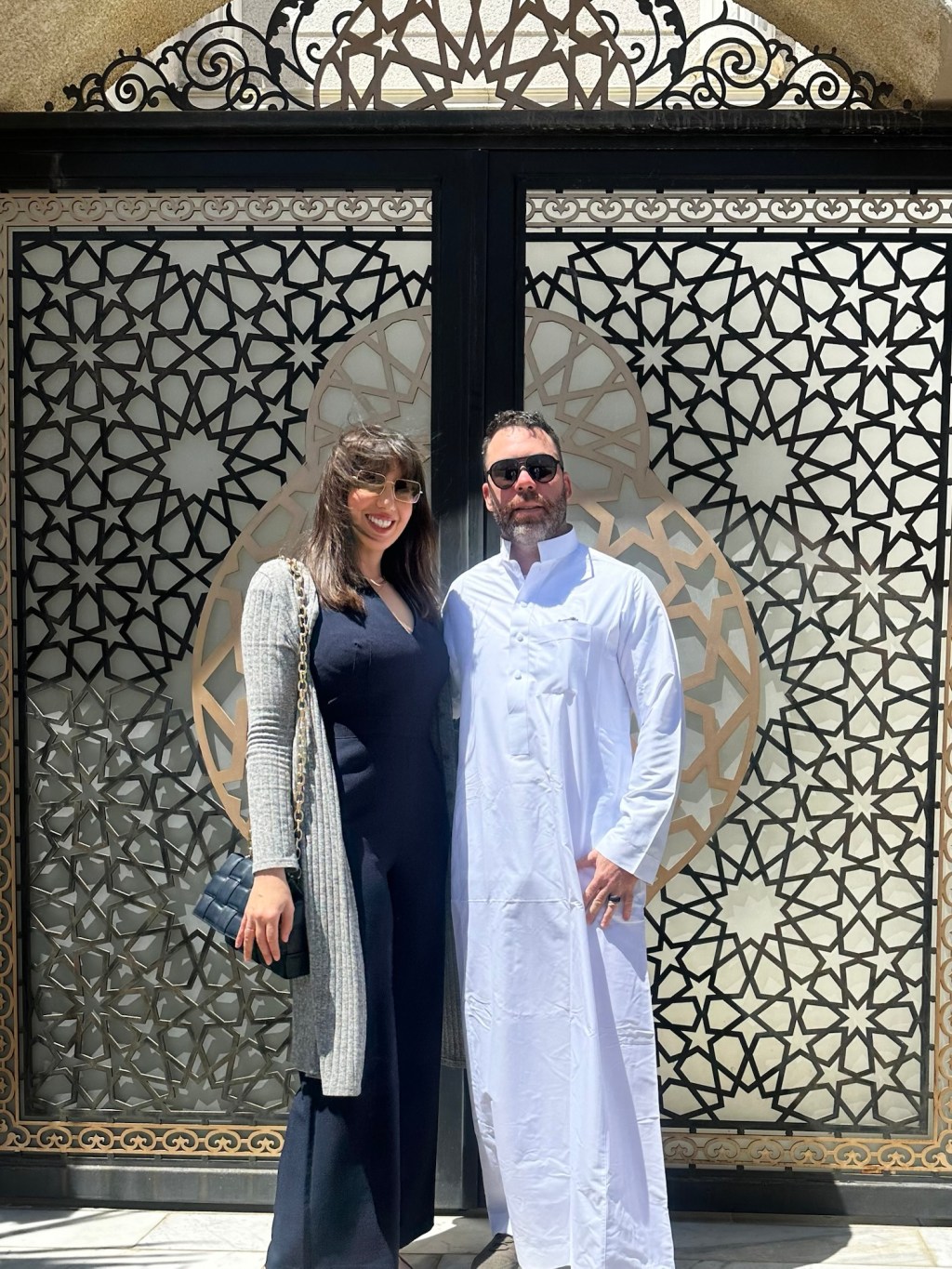
JEDDAH – April 13, 2025. “Alhamdulillah ala salama” (thank God for your safe arrival), the immigration officer said while stamping my passport. I had officially returned to Jeddah after a 25-year absence.
The ghost of Iqamas past
As our Saudi Airlines flight SV256 from Istanbul descended into Jeddah, I braced myself for something I hadn’t experienced in a quarter century: that sudden immersion into hot, humid air which would envelop me completely upon reaching the tarmac stairs. Each heavy inhale labored with sea salt and desert dust.
But this time, everything was different. Instead of stairs, we emerged through a jetway directly into the air-conditioned terminal. The absence of that sensory jolt was my first hint that I was entering a changed Saudi Arabia.
I could almost feel the ghost of my younger self returning from summer visits to my grandparents’ loving home in Amman, only to be greeted by the stark reality of re-entering Saudi Arabia as a non-citizen. That mixture of climate shock and bureaucratic dread was once as much a part of my arrival routine as baggage claim. But today, those memories collided with a very different reality.
In the ’80s and ’90s, our lives were governed by the iqama system, Saudi Arabia’s residency permit program for foreigners. My father had been an Iqama holder since the late ’70s, and our family’s legal residency hinged entirely on his employment. These permits controlled crucial aspects of our lives: our movements, opportunities and daily interactions within Saudi society.
The bureaucracy surrounding our status was inflexible and constant. Officials documented every entry and exit meticulously through a process called khorooj wa awda (exit and return visa). Though I initially left Saudi Arabia at 17 to study abroad, I continued renewing my residency documents during visits. However, after returning at age 20, I made a decisive choice: I wouldn’t renew these papers again, effectively cutting my legal ties to the country where I’d grown up and formed my identity.
A new Saudi Arabia emerges
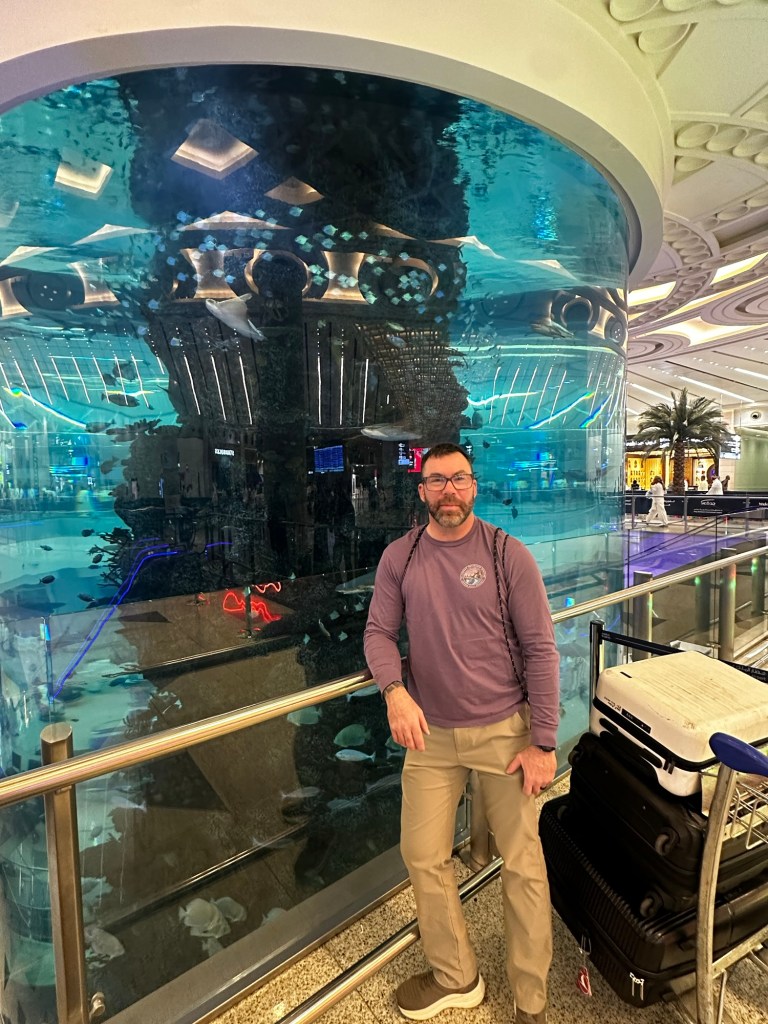
Instead of the chaotic, crowded arrival hall of my youth, we were smoothly guided through the terminal on a sleek automated train. All around us, Saudi men and women worked side by side, an unimaginable sight from my past. They greeted passengers cordially, efficiently guiding the flow of travelers, their interactions professional yet infused with that distinctly Saudi hospitality I had grown up with.
But the most profound change awaited us at passport control. I approached the counter with my American passport, Nat standing behind me, bracing myself for questions or complications, a residual anxiety from my past experiences. Instead, I was greeted by a young Saudi woman confidently operating the immigration system. She expertly and politely guided me through the advanced biometric requirements for entry, stamped my passport, and welcomed me back to Saudi Arabia.
This simple interaction would have been unthinkable during my childhood in Saudi Arabia. Women working in public-facing roles at the airport? A female immigration officer? The Saudi Arabia I grew up in kept women largely segregated from such positions.
The contrast with the ’80s and ’90s that I knew is stark. Back then, only about 5-10% of women participated in the formal workforce at all, and they were almost exclusively confined to education (teaching in all-female schools) and healthcare (working in women’s sections of hospitals). Government positions for women were extremely limited, and public-facing roles like airport immigration or customs were exclusively male domains where female employment was impossible due to strict gender segregation policies.
Today, female workforce participation has grown to over 35% by 2023. Women began working in airport immigration and customs positions around 2018-2019, coinciding with a series of royal decrees removing employment restrictions and the Ministry of Labor’s 2019 elimination of gender segregation requirements in workplaces. What strikes me most is not just seeing women in these roles, but how normal it appears now, a shift that happened swiftly after decades of rigid segregation.
The tourist visa revolution
The ease of Nat’s and my entry is largely thanks to Saudi Arabia’s 2019 tourist visa initiative, part of the ambitious Vision 2030 reform program. This landmark policy opened the country to international visitors from 49 countries, including the United States. For the first time in its modern history, Saudi Arabia began actively welcoming tourists rather than limiting entry primarily to religious pilgrims, business travelers and expatriate workers.
The irony wasn’t lost on me, I now had easier access to Saudi Arabia as an American citizen than I ever did as a resident. Had I traveled on my Jordanian passport instead of my American one, I would have faced a more complicated visa process requiring embassy visits and additional documentation. Saudi Arabia’s e-visa program excludes most Arab nations, creating the paradox that my Western citizenship provided easier access to an Arab country than my Arab identity documents would have.
Meanwhile, my parents, still operating within the iqama system, were processed in a separate area designated for residents. The situation had flipped: my American passport now gave me more freedom to go in and out of Saudi Arabia than their decades-long residency status.
The mahram requirement: Then and now
For years, the mahram requirement had been strictly enforced for women, making independent travel very difficult.
In 2019, as part of the same modernization efforts, Saudi Arabia officially abolished the mahram requirement for women over 21 traveling to the country. Before this change, all women, regardless of age, needed male guardian approval and accompaniment for travel. The royal decree that eliminated this restriction was a watershed moment for women’s mobility rights in the Kingdom.
Standing there at immigration, I was overcome with emotion. The last time I had entered this country, my father had to be physically present, his name had to be on documents permitting my travel, and my existence in Saudi Arabia was legally tied to his. Now, I was here on my own terms, with my chosen husband rather than a guardian, in full possession of my own agency.
The enduring grace of diyafeh
One cultural element that remains beautifully unchanged is diyafeh, the deeply-rooted Saudi tradition of hospitality and graciousness toward guests. Growing up here, this was always the counterbalance to the strict governmental regulations and bureaucracy. While the system could be challenging to navigate, the people themselves were unfailingly kind, respectful, and welcoming.
Visitors in Arab homes are treated like royalty: offered the best seats, served elaborate meals, and showered with attention and generosity. This wasn’t just in private settings but extended throughout society. Shopkeepers offered tea, strangers helped with directions, and there was always an underlying current of respect and dignity in personal interactions.
What many outsiders never saw during the years of restricted access was how worldly, educated, and sophisticated many Saudis were behind closed doors. In private settings, I grew up around Saudis who spoke multiple languages, had studied abroad, were versed in global literature and arts, and maintained nuanced perspectives on world affairs. This cosmopolitan side existed long before the recent openings, but remained largely hidden from the global view.
Now, as Saudi Arabia opens its doors wider, this deeply rooted tradition of diyafeh is emerging onto the world stage. The hospitality I always knew in private spaces is becoming more visible as restrictions ease and the society becomes more accessible. The warmth, generosity, and gracious demeanor that characterized my childhood interactions with Saudi nationals are now elements that international visitors can experience firsthand.
Alongside these cultural continuities, unmistakable changes have taken root. Women drive on the same streets where they often couldn’t even sit in the front passenger seat, a reform that came in June 2018 when King Salman’s historic royal decree ended the world’s last ban on women driving. Mixed gender spaces are becoming more common, particularly after the Ministry of Labor eliminated requirements for separate entrances and work areas for men and women in 2019. Technology has transformed everyday life, with digital payment systems, ride-sharing apps, and social media now ubiquitous.
Coming full circle
As we settled in for the evening in Jeddah, my brother Hameed had made good on his promise: an order from Al Baik, the cult-favorite fried chicken chain established by a Palestinian immigrant in 1974, was waiting for us. The first bite transported me instantly through time; the signature garlic sauce and perfect fries hitting my taste buds exactly as I remembered. Yet the chicken itself, unchanged after all these years, somehow didn’t taste quite as magical as it once had. Perhaps taste buds evolve just as people and places do.
When I left, I was a teenager uncertain about my place in the world. I return now as an American citizen, a professional, a wife, with a deeper appreciation for both the challenges and the strengths of growing up between cultures.
I never imagined that one day I would return to Jeddah with an American husband, be welcomed by a female immigration officer and navigate the country with more freedom than I ever had growing up here. Yet here we are.
Sitting in my parents’ new kitchen in the transformed kingdom, I realized what I’d truly gained over these 25 years: the ability to move through the world on my own terms.. This hard-won independence felt especially meaningful in a place where such autonomy was once impossible for me.
Contrasts between memory and reality struck me at every turn. Past and present collided as I witnessed what was once forbidden now becoming commonplace. I felt an overwhelming sense of witnessing history in motion. This journey filled me with deep gratitude, helping me reconcile parts of my identity I had long kept separate.



Related reading:
- Reuters. (2021, November 4). “Saudi women barrel into workforce in changing kingdom.” https://www.reuters.com/world/middle-east/saudi-women-barrel-into-workforce-changing-kingdom-2021-11-04/
- Arab News. (2023, May 30). “Saudi women’s labor force participation rate hits 36%.” https://www.arabnews.com/node/2567745/business-economy
- New York Times. (2017, September 26). “Saudi Arabia Agrees to Let Women Drive.” https://www.nytimes.com/2017/09/26/world/middleeast/saudi-arabia-women-drive.html
- CNN. (2019, December 9). “Saudi Arabia ends restaurant segregation.” https://edition.cnn.com/2019/12/09/middleeast/saudi-arabia-gender-restaurants-intl/index.html
- Arab News. (2019, September 21). “Jeddah airport’s new terminal attracts Saudi couples for prewedding photo shoots.” https://www.arabnews.com/node/1560491/saudi-arabia
 Heritage Homecoming
Leave a comment