
ISTANBUL, April 9, 2025 – After descending Galata Tower, we began our walk down İstiklal Avenue, a bustling pedestrian street stretching 1.4 kilometers (about a mile) to Taksim Square. İstiklal wasn’t quite as I remembered from my only trip to Istanbul back in 2014. Souvenir vendors now mostly offer mass produced trinkets rather than local crafts. Many traditional shops have been replaced by chain stores.
Despite my initial disappointment, the street still pulsed with authentic energy. I enjoyed some fresh-squeezed pomegranate juice as the historic red tram clanged through crowds. Street musicians created a soundtrack to our walk, while the aroma of freshly baked simit mixed with grilled kebabs. Together, they created that distinctive Istanbul sensory experience.
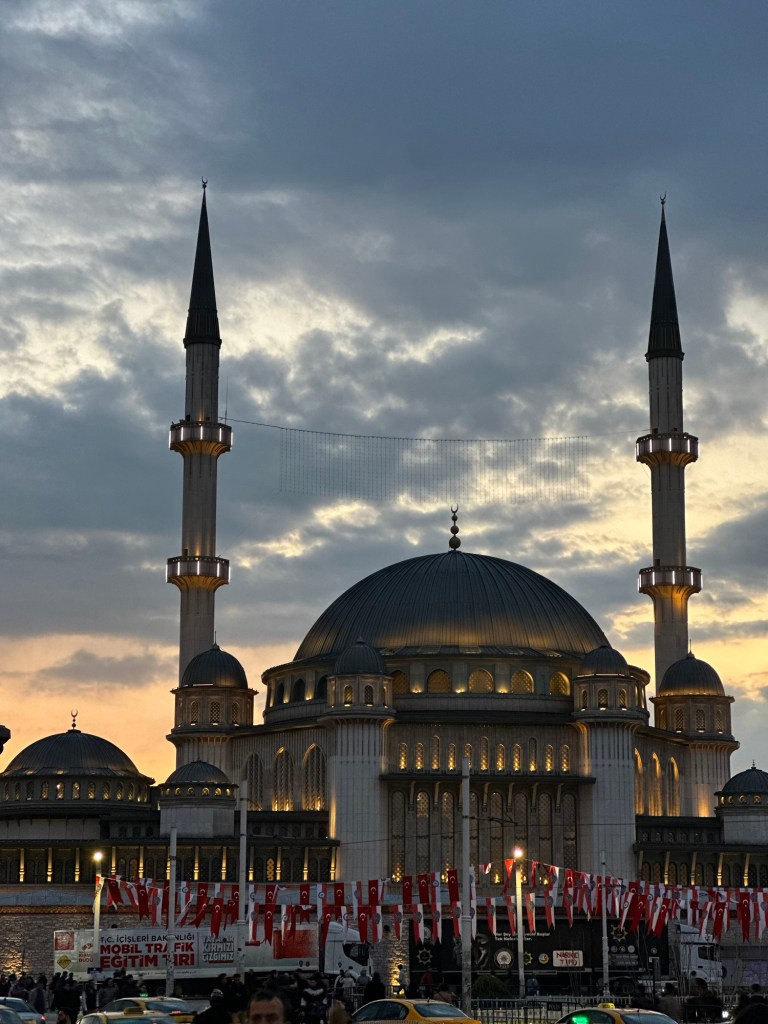
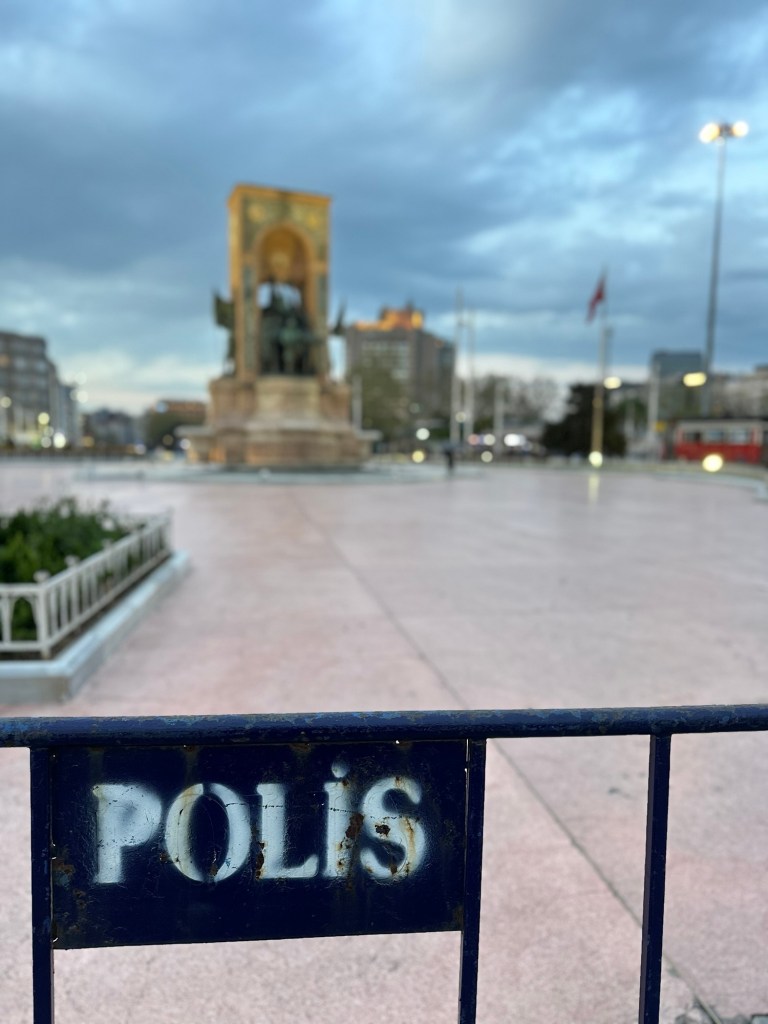
As we approached Taksim Square, I noticed increased security. The square itself was partially cordoned off with construction barriers. This square, once known as an open public forum, now seemed more regulated. The physical changes reflected the political climate.
As we began the long drive back to Beylikdüzü, I asked Ender, our driver, whether the closure was to prevent protests. It was a bold and abrupt question on my part. He matched my directness with candor, talking about the square’s contentious recent history. He focused particularly on the tensions between Istanbul’s popular mayor, Ekrem İmamoğlu, and President Erdoğan.
What struck me most during our conversation was Ender’s passionate defense of Turkey’s secular identity. “Turkey has proven itself on being secular,” he said with unmistakable pride, gesturing toward a billboard featuring Atatürk.
Throughout the day, I noticed his portraits hanging everywhere we went. It wasn’t merely official homage but seemed to reflect genuine affection from ordinary citizens.
Ender also offered a nuanced perspective on current politics. “Today’s government,” he explained, “they use Islam to connect with voters.” He described how President Erdoğan’s administration had gradually shifted away from Atatürk’s strict secularism. “Most young people and educated people don’t support this,” he added. “Erdoğan makes people afraid that secularism threatens Islam, but that’s not true.”
Before I could ask follow-up questions, Ender continued to explain what I’d seen across many Arab countries. Turkey had always seemed different and more progressive to me. “There are laws against insulting the president,” he said, now lowering his voice despite being alone with us in the car. “People can be investigated or even face prison time.” He described how critics sometimes find police at their door in early morning raids.
Recent headlines about Turkey had already confirmed what Ender described: stories of dawn raids and systematic crackdowns.
I thought of the Syrian uprising that began during the 2011 Arab Spring. More recently, hundreds of political prisoners were released from Sednaya Prison on December 8, 2024. Many had been held and tortured for over a decade without trial. Their only crime was participating in peaceful protests, posting on social media, or even spraying anti-Assad graffiti as teenagers. Tens of thousands of prisoners are believed to have died there from torture, starvation, and execution since 2011. Like many who grew up in the region, I recognized the familiar pattern of voices automatically lowering when conversation turned to politics.
I glanced at Nat, reserved as always. He said nothing. Even in his composed face in the fading light of dusk, I could read his unspoken thoughts. We’ve talked about this before. As a veteran who had joined the Marines and taken an oath to “defend the Constitution of the United States,” Nat had become disillusioned upon discovering the difference between American values and American “interests.” He even protested the Iraq war after getting out. Yet the concept of being arrested for protest or free speech still clashed with his deeply held American values. For me, having grown up in the Middle East, it was just part of reality.
As the car hummed, rocking me into a drowsy state, my mind drifted between worlds. How differently we experience life, yet our needs remain universal. Across continents, oceans and cultures, we all dream of similar things: safety, dignity and freedom. These universal desires transcend borders and political systems. They connect us despite our different lived experiences.
Looking back on our whirlwind day, Istanbul had already revealed itself as a city of fascinating contradictions. Too often, I’ve encountered reductive views of secularism as merely a Western aspiration. Others wrongly see the Middle East as a monolithic entity defined only by religion or conflict. The reality I lived in the past and witnessed today, decades later, is far more complex.
In one day, I sailed between continents on the Bosphorus, tasted childhood memories in roasted chestnuts, and witnessed the tension between Atatürk’s secular vision and powerful religious currents.
Istanbul, neither fully Eastern nor Western, stands uniquely at the crossroads of history and geography. Turkey’s experience rejects the dichotomy between tradition and progress, revealing how societies carve complex paths through competing forces. However jet-lagged we were, tomorrow’s adventures at the Blue Mosque, Hagia Sophia and Topkapı Palace promised fresh revelations in this endlessly multifaceted city.


Related reading
BBC. (March 2025). “Don’t speak, don’t film: Journalist arrests fuel fears for democracy after Turkey protests.” https://www.bbc.com/news/articles/c5ypxedzny4o
Le Monde. (March 28, 2025). “Jailed Istanbul mayor Imamoglu says his lawyer has been arrested.” https://www.lemonde.fr/en/international/article/2025/03/28/jailed-istanbul-mayor-imamoglu-says-his-lawyer-has-been-arrested_6739595_4.html
Al Jazeera. (December 8, 2024). “In Aleppo, freed prisoners recall the horrors of the past.” https://www.aljazeera.com/news/2024/12/8/in-aleppo-freed-prisoners-recall-the-horrors-of-the-past
NBC News. (February 23, 2025). “Syrian teenager sprayed four words on a wall that started an uprising.” https://www.nbcnews.com/news/world/syrian-teenager-sprayed-four-words-wall-started-uprising-rcna188357
 Heritage Homecoming
Leave a comment